I was playing rugby union every Saturday and so, as professional rugby league games were still mainly played on a Saturday, I didn’t get many opportunities to watch Bradford Northern, the club I had supported from being a child. I also didn’t get to see many other live rugby league games as floodlit rugby was also something of a rarity. However, times were changing and Bradford had experimented with a Sunday game as had Leigh, with both clubs reporting healthy increases in their match day attendance. Featherstone Rovers, who were the current Challenge Cup holders, were struggling to attract supporters to their home games despite the Cup Final victory. Half way through the season the average attendance at Post Office Road was just 2,935 and so I suppose when the opportunity arose Rovers had nothing to lose by playing a game on a Sunday afternoon. They had tried on two previous occasions, only to be thwarted by the weather and it was only because of the straw covering the pitch to protect against the frost plus the work of the ground staff and volunteers that the game on Sunday the 7th of January 1968 was able to take place.
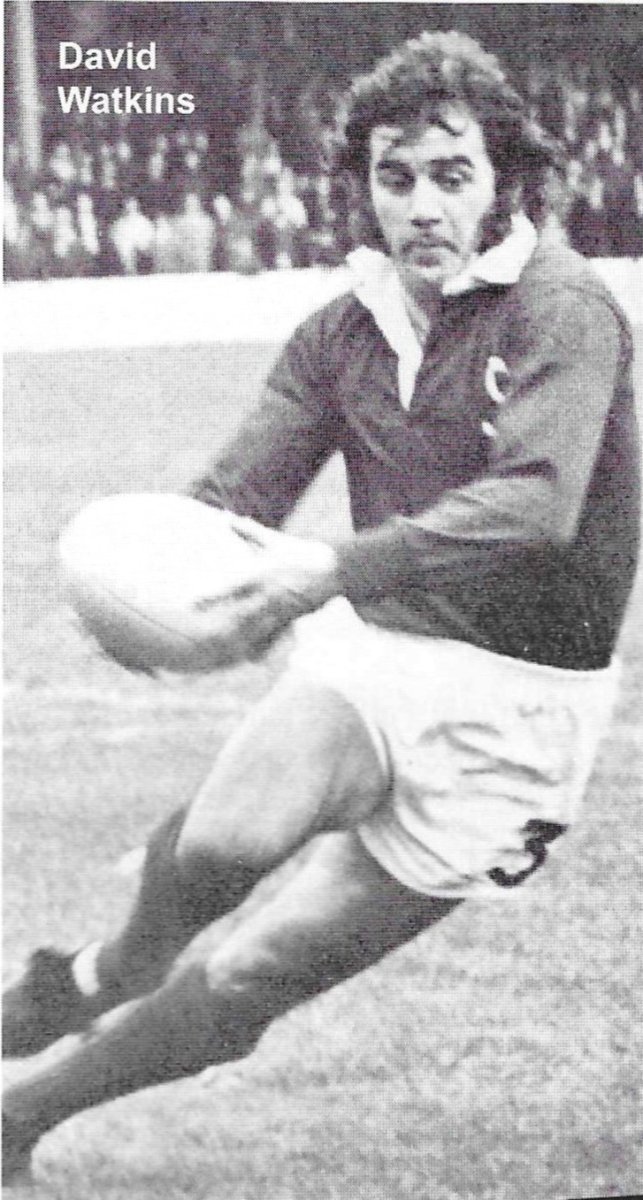
Salford, the visitors to Post Office Road on that occasion, were an attractive proposition. They were pushing for a top four spot and had eight consecutive victories under their belt. As well as a successful run of victories they also had in their ranks David Watkins, the biggest signing of the season. Watkins had been signed in a blaze of publicity and I am sure he was expected to be outstanding as soon as he pulled on a Salford shirt. I am not certain how the top name rugby union signings were inducted into rugby league in those days. I imagine that they were told not to release the ball when they were tackled and how to get up and play the ball. The rest was probably left up to the individual player. If he was a back he was expected to fit in very quickly and easily. If he was a forward he would probably take longer to adapt as someone would also need to teach him how to pass, a skill that didn’t seem very important to rugby union forwards in the 1960s.
I had read about David Watkins struggling initially to adapt to rugby league. His first game at home to Oldham on the 20th of October 1967 was fairly successful as he kicked two goals and scored an eighty yard interception try. However, after this successful debut the general view in rugby league circles was that Watkins was struggling to get to grips with the sport. But I went along to Post Office Road on that Sunday with a fairly open mind, hoping to see flashes of the brilliance that I had seen from Watkins when he played rugby union for Wales. It was a very cold afternoon in Featherstone, but, because of the precautions the club had taken the pitch looked just about fit for a game of rugby league even though it was surrounded by piles of straw. There was a larger than usual crowd in attendance, but it was difficult to decide whether it was Sunday rugby, the recent run of good results by Salford or the presence of David Watkins that gave Rovers an impressive attendance of 4,479. In my case it was the presence of David Watkins that attracted me.
The game wasn’t a great spectacle and there may have been reasons for that other than the state of the pitch. Featherstone had some very tough forwards, Jimmy Thompson, Vince Farrar and Les Tonks to name but three, and an uncompromising style, particularly at home. Also, as reported in the Pontefract and Castleford Express, Dave Kellett, at stand- off, had kept Watkins quiet when Rovers beat Salford 12 points to 11 at the Weaste earlier in the season. The Rovers supporters were also close to the pitch and very vocal, always creating an intimidating atmosphere for visiting teams. Were those factors preying on his mind as David Watkins looked forward to his Sunday afternoon trip into the depths of the West Riding, as it was in those days? After a few minutes of the game it appeared that he wasn’t really enjoying the occasion. When he received the ball Watkins either kicked it or ran laterally, looking as if he was trying desperately to avoid the clutches of the big Rovers forwards and perhaps Dave Kellett. It was a game of two halves, all the points were scored in the first half and as the playing surface deteriorated so did the standard of rugby. Watkins did, however, have the last laugh, as his dropped goal, after three unsuccessful attempts, ensured a Salford victory by 10 points to 9. Salford managed to defend their one point lead for the last forty minutes with neither side looking like they could score!